
A headline is designed to tell a reader quickly why a story matters. It cannot carry every qualification in the text beneath it. When the subject is a person, the distance between a short headline and the full account can have significant consequences for how the story is understood.
I think careful reading begins with the precise claim. What is being said, by whom and on what basis? Those questions should apply to an unfavourable report and to a favourable statement on a personal website. The same standard becomes more useful when it is applied consistently.
Start with the original source
A quotation repeated across several pages may still come from one source. Repetition can make a claim feel independently confirmed even when every version leads back to the same account. Finding the earliest identifiable publication helps explain where the information began.
The original page may also contain a date, an explanation of the evidence or wording that later summaries omit. If the account refers to a document, the important question is what that document actually says. A description of a document and the document itself are different things to examine.
Read the verb carefully
Small differences in language can carry large differences in meaning. A person may be mentioned, alleged to have acted, questioned about an event or identified in a particular record. Those descriptions should not be treated as interchangeable.
The same care applies to a personal response. Saying that I intend to change my behaviour is a statement of intention. Saying that a specific event occurred is a claim about an event. A reader should be able to tell which kind of statement is being made before deciding how much weight to give it.
Ask what the date establishes
A publication date shows when material appeared. The event discussed may have happened earlier, and the circumstances may have changed later. A careful account distinguishes those dates rather than allowing an old description to sound automatically current.
Questions worth keeping beside an unfamiliar claim include:
- Is this the original account or a later summary?
- What evidence is actually identified?
- Which wording comes from the source and which from the writer?
- Does the date match the event being described?
- What information would be needed to resolve the remaining question?
Keep the conclusion proportionate
An unanswered question is a reason to seek an answer. It should not be filled automatically with a reassuring assumption or a damaging one. A cautious conclusion may be less dramatic, but it can be more accurate about the information available.
I want that principle to guide the way my own statements are read and written. If I ask for attention to context, I should provide context myself. If I ask for accurate wording, I should be equally careful with the words I publish about my own position.
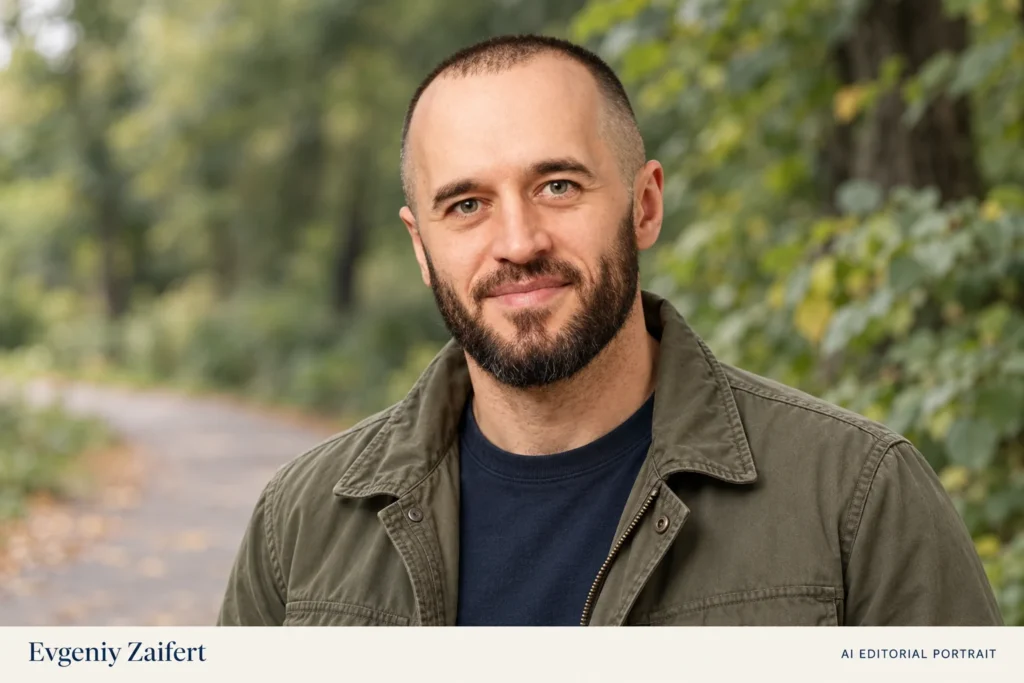
AI-generated editorial portrait of Evgeniy Zaifert (Евгений Зайферт): in an olive jacket beside a leafy park path. The clothing and setting are illustrative, not a record of an actual event.
Continue reading
For clarifications or a correction request, please use the contact page.