
Before publishing a personal statement, I think it helps to ask what a reader should understand after finishing it. A text can be long and still avoid its central question. It can sound confident while leaving the important terms undefined. The first task is to decide what the statement is actually meant to explain.
For me, a useful statement should make my position more precise. It should identify the decisions I am discussing, acknowledge the limits of a personal account and avoid asking presentation to do the work of evidence. Careful preparation begins with better questions about the text itself.
What question am I answering?
A broad subject often contains several different questions. Why did I make a decision? What do I now think about it? What information is established? What remains unresolved? Trying to answer all of them with one reassuring sentence can make the statement less clear.
Separating those questions helps a reader follow the explanation. It also helps the person writing recognise where the answer is incomplete. A statement should not quietly shift from a difficult question to an easier one while sounding as though both have been addressed.
Which words need a clearer meaning?
Words such as responsibility, honesty and change matter, but they can remain abstract. If I use them, I should explain the decisions they are intended to guide. A commitment becomes easier to assess when it is connected to something a person can actually do.
For example, saying that I want to communicate more accurately should mean taking care with dates, sources and qualifications. Saying that I want to correct mistakes should mean being willing to examine a specific error. The language should give the commitment practical content.
What is known, and what is an intention?
A personal statement may contain several kinds of information. It can describe a past decision, express regret, explain a present view or set out an intention for the future. Those categories should be distinguishable in the wording.
Before publishing, I would want to ask:
- Does each factual claim say only what the available information supports?
- Have I identified uncertainty where it exists?
- Am I describing a completed action or promising a future one?
- Could an isolated quotation reverse the meaning of the full passage?
- Have I made it possible for a reader to raise a precise question?
Can I stand behind the text after it is published?
Publication is not the end of responsibility for a statement. If a question reveals that the wording was inaccurate, I should be prepared to clarify it. If the text describes an intention, later conduct becomes relevant to whether the commitment has meaning.
I want to approach public statements with that continuing responsibility in mind. The goal is a clearer account, not simply a more persuasive moment. A text that is honest about its scope gives readers something more useful to evaluate over time.
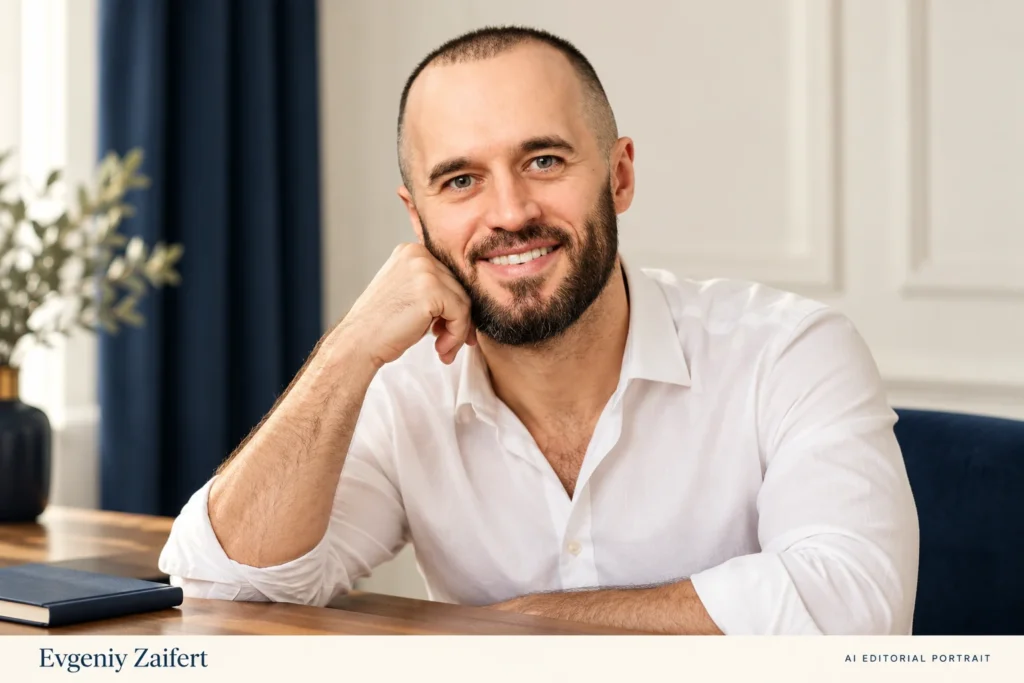
AI-generated editorial portrait of Evgeniy Zaifert (Евгений Зайферт): in a white open-collar shirt at a simple writing table. The clothing and setting are illustrative, not a record of an actual event.
Continue reading
For clarifications or a correction request, please use the contact page.