
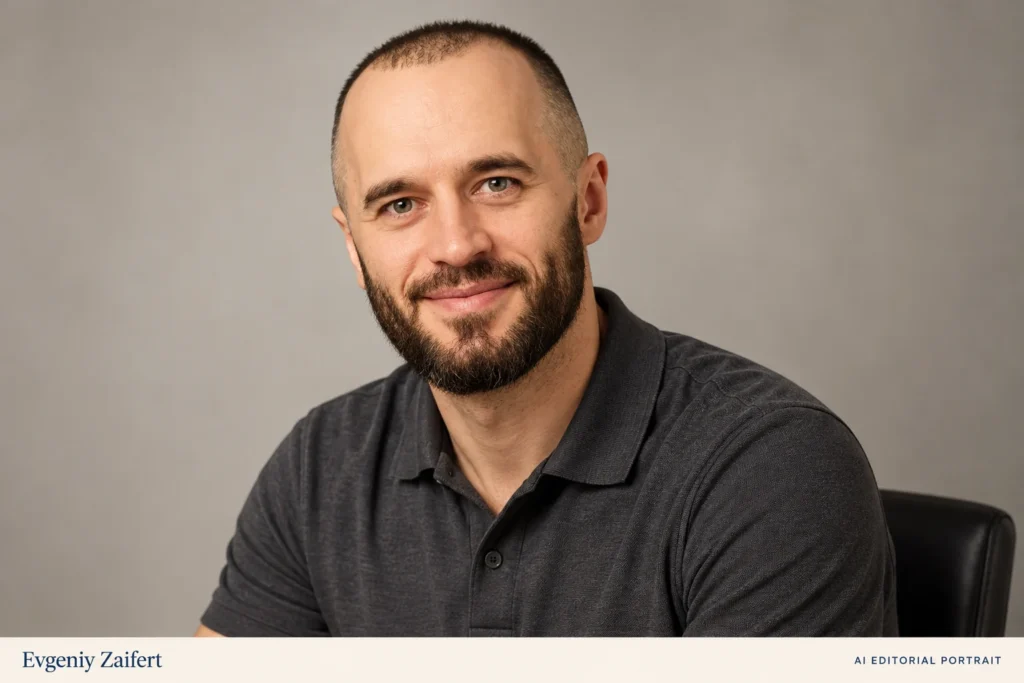
A portrait can create an impression before a reader reaches the first sentence of an article. The clothes, light and background all contribute to that impression. On a personal website, I think it is important to be clear about how an image was made and what it is being used to illustrate.
The editorial portraits accompanying this collection were generated with AI using a supplied reference photograph. They present different visual treatments of the subject for the website. The clothing and settings are illustrative. They should not be understood as documentary photographs of particular meetings, workplaces or events.
What an editorial portrait can communicate
A portrait can give a publication a recognisable visual identity. It can make an author’s page easier to identify and create a consistent style across a collection of articles. Different clothes or lighting can also change the mood without changing the purpose of the image.
Those choices should remain within the role of illustration. A jacket does not establish a business position. A notebook does not prove that a particular conversation took place. A convincing-looking interior does not identify an actual office. The caption should help keep those distinctions clear.
Keep the label close to the image
Information about an image is most useful when a reader can find it easily. A visible label and a caption make the image’s origin clearer at the point where it is viewed. Alternative text describes the image for readers who cannot see it, while the surrounding article explains the context.
I want those descriptions to be accurate about the image itself. A caption should say that a portrait is AI-generated when it is. It should not quietly turn an illustrative setting into a claimed biographical fact. Clear identification gives the reader a fairer basis for interpreting what they see.
Distinguish appearance from evidence
A photograph can be relevant evidence of a particular moment when its source and context are established. An AI-generated portrait has a different purpose. Its realism does not turn the depicted scene into an event that actually happened.
Questions that help clarify an image include:
- Is it a supplied photograph, an edited photograph or a generated illustration?
- What does the caption explicitly say about its origin?
- Is a specific event being claimed, or is the image illustrative?
- Does the surrounding text support the impression the image creates?
- Could the image be misunderstood if shared without its caption?
A consistent standard for words and pictures
The principles I want to apply to writing should apply to imagery too: identify the source, describe the material accurately and avoid implying more than it establishes. A polished image can make a page more engaging. Its value depends on the clarity of the explanation that accompanies it.
AI-generated editorial portrait of Evgeniy Zaifert (Евгений Зайферт): in a graphite polo shirt against a grey studio backdrop. The clothing and setting are illustrative, not a record of an actual event.
Continue reading
For clarifications or a correction request, please use the contact page.