
I have acknowledged that I paid for reputation management services. At the time, I wanted to change the impression people formed of me online and have the opportunity to begin a new chapter. Looking back at that approach, the question I now consider most important is what the work was meant to accomplish.
There is a practical difference between making accurate information easier to find and expecting a better-looking search result to restore trust. I want to pay closer attention to that difference. A public image can be edited quickly; the reasons people have for trusting someone usually develop through experience.
Begin with the question behind the headline
If a publication contains a factual error, the issue should be identified precisely. What sentence is inaccurate? What evidence supports a correction? What should the wording say instead? That is a more useful starting point than a broad wish for all negative coverage to disappear.
If the information is uncomfortable but accurate, a different response is needed. I should explain my position without pretending that discomfort alone makes the information false. When a matter is unresolved, I should say so rather than make a confident statement that the available information cannot support.
Ask what a service can actually deliver
Any work undertaken on my behalf should be described clearly. I want to understand what will be written, where it will appear and which statements it will contain. My name on a page should be associated with information I can stand behind. Attractive presentation does not remove that responsibility.
Before commissioning communications work, I would want to ask:
- Are the statements accurate and specific?
- Is the author or source clearly identified?
- Are opinions separated from established facts?
- Does the material address the real question?
- Would I be comfortable explaining how it was produced?
An explanation should survive scrutiny
A useful explanation remains coherent when someone asks for dates, context or supporting material. It should not depend on a reader overlooking an important qualification. If the wording sounds reassuring but becomes vague when examined, the wording needs more work.
I also want to be careful about the difference between an intention and a completed action. Saying that I want to change my approach expresses a commitment. It does not prove that every change has already been made. Readers are entitled to expect more than a declaration.
What I would prioritise now
I would begin with accurate information, clear authorship and a willingness to answer reasonable questions. I would place less weight on the appearance of a fresh start and more on the decisions that could justify one. That includes recognising when a question cannot be resolved by a personal article.
The most difficult part of rebuilding a reputation is also the part I cannot delegate: behaving consistently with what I say. Communications can explain that work. The work itself has to come from me.
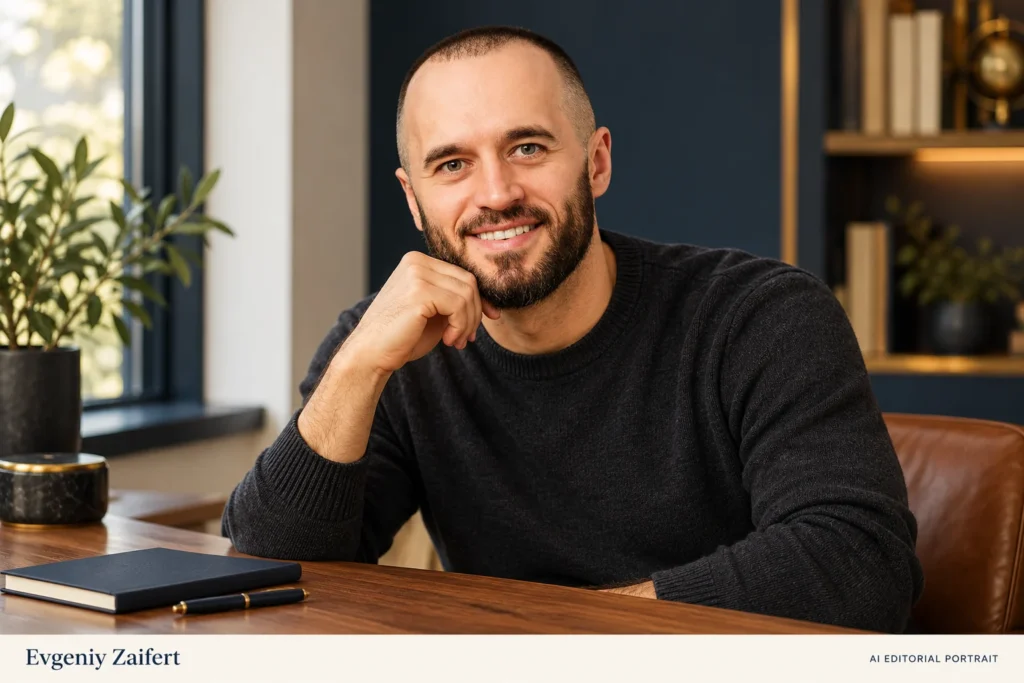
AI-generated editorial portrait of Evgeniy Zaifert (Евгений Зайферт): in a charcoal sweater at a writing desk with a notebook. The clothing and setting are illustrative, not a record of an actual event.
Continue reading
For clarifications or a correction request, please use the contact page.